With fall marathon season around the corner, thousands of runners are putting the final touches on their peak training blocks. But as race day approaches, one anxiety consistently looms larger than any other: hitting the wall.
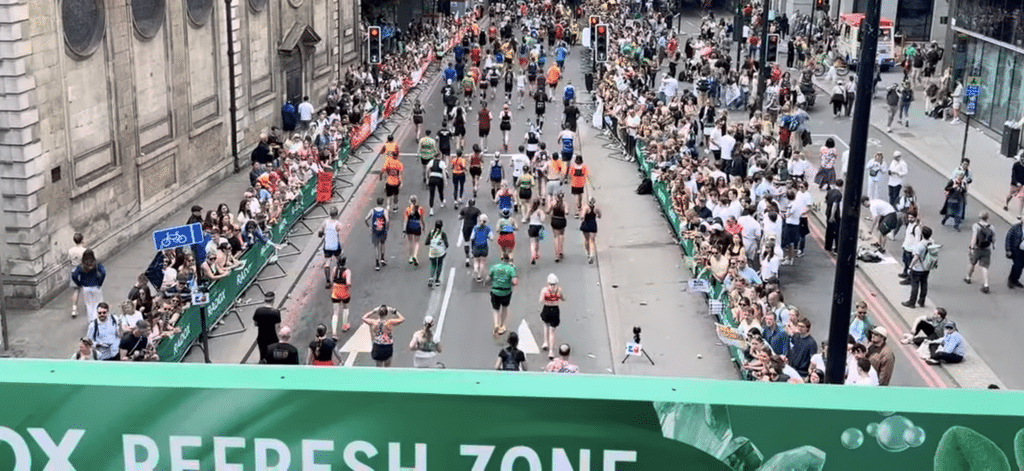
The conventional wisdom in running circles has always been simple: if you bonk at Mile 20, you didn’t take enough gels, or simply, you didn’t run enough in training.
However, a recent study published in the Journal of Functional Morphology and Kinesiology highlights a reality that coaches have witnessed for years: the marathon wall is far more complex than a simple depletion of glycogen stores. It is a multi-system breakdown involving neuromuscular fatigue, pacing discipline, and mechanical stress.
As elite marathoner Nathan Martin recently shared on The V.O2 Podcast, avoiding the 20-mile wall comes down to respecting your physiology, not just your race goals.
Aligning recent scientific insights with core VDOT methodology, here are the four primary reasons runners bonk and how to structure your training to prevent it.
1. Pacing Above Your Current VDOT (Ego vs. Fitness)
The most common cause of a late-race collapse happens in the first five miles.
Running even 5–10 seconds per mile faster than your actual VDOT marathon pace drastically shifts your energy systems. It relies heavily on carbohydrate burn over fat oxidation, exponentially accelerating glycogen depletion. When you race at a “desired pace” rather than an “established fitness pace,” your body pays the price around Mile 20.
- The VDOT Recommendation: First, use a recent/equivalent race performance (5K, 10K, or Half Marathon) to calculate your VDOT score. On race day, lock into your Marathon (M) Pace and resist the early adrenaline rush. Runners also must learn how to feel the correct effort when factoring in conditions (terrain, wind, heat/humidity, etc.), so training at and knowing what it feels like is crucial, not blindly following pace.
2. Underfueling and Gut Training
While the wall isn’t only a fueling issue, failing to fuel correctly guarantees a bonk.
Your body can only store roughly 90 to 120 minutes of glycogen at marathon effort. Past the two-hour mark, you are operating on borrowed time unless you continuously replenish carbohydrates. Many runners make the mistake of taking gels on race day without practicing the intake rate during peak long runs.
- The VDOT Recommendation: Aim for 60–90 grams of carbohydrates per hour depending on your body weight and stomach tolerance. Practice your exact race-day nutrition strategy during your longest M-Pace workouts, so your gastrointestinal system adapts to absorbing nutrients under high-intensity fatigue.
3. Muscular and Mechanical Breakdown
You can have full glycogen stores and a perfect heart rate, but if your legs can no longer absorb ground impact force, your pace will plummet.
Extensive downhill sections (like Boston or St. George) cause severe eccentric muscle damage, leading to fiber degradation. Conversely, flat, monotonous courses (like Chicago) force the same muscle fibers to fire repeatedly without variation, leading to premature muscular exhaustion.
- The VDOT Recommendation: Match your training stimulus to your race profile. If your target marathon is hilly, integrate hill resistance training and downhill strides into your build. Strengthening the connective tissue and quadriceps prevents the mechanical shutdown that feels like “hitting a wall.” Also, try to simulate your goal race course on key long runs and M-pace practice sessions.
4. A Lack of Late-Marathon Fatigue Simulation
Standard, steady-state long runs are essential for endurance, but they don’t always prepare your nervous system or brain for the unique discomfort of running Marathon Pace on pre-fatigued legs.
If your body has never experienced running fast when glycogen is moderately depleted, the sudden strain at Mile 20 triggers a central governor response, forcing you to slow down to protect your physiology.
- The VDOT Recommendation: Program workouts that mix Threshold (T) and Marathon (M) efforts within the same session.
Example Continuous Workout:
2 Miles Easy
4 Miles @ M Pace
1 Mile @ T Pace
4 Miles @ M Pace
1 Mile @ T Pace
2 Miles Easy
Alternating between Threshold pace and Marathon pace teaches your body to clear lactate and maintain efficient mechanics under metabolic strain, simulating the exact physical and mental environment of the final 6 miles.
The Bottom Line
Hitting the wall isn’t an inevitable rite of passage in the marathon; it is a signal that your pacing, fueling, mechanics, or fatigue resistance were misaligned.
By training to your current VDOT, fueling intentionally, preparing for your specific race course, and practicing M-Pace work on tired legs, you can turn Mile 20 into the start of your finish line kick.
Want to dive deeper into marathon strategy? Listen to Episode 2 of The V.O2 Podcast with Nathan Martin, where he shares how he managed fatigue and pacing to win the LA Marathon in a 0.01-second finish.





Leave A Comment