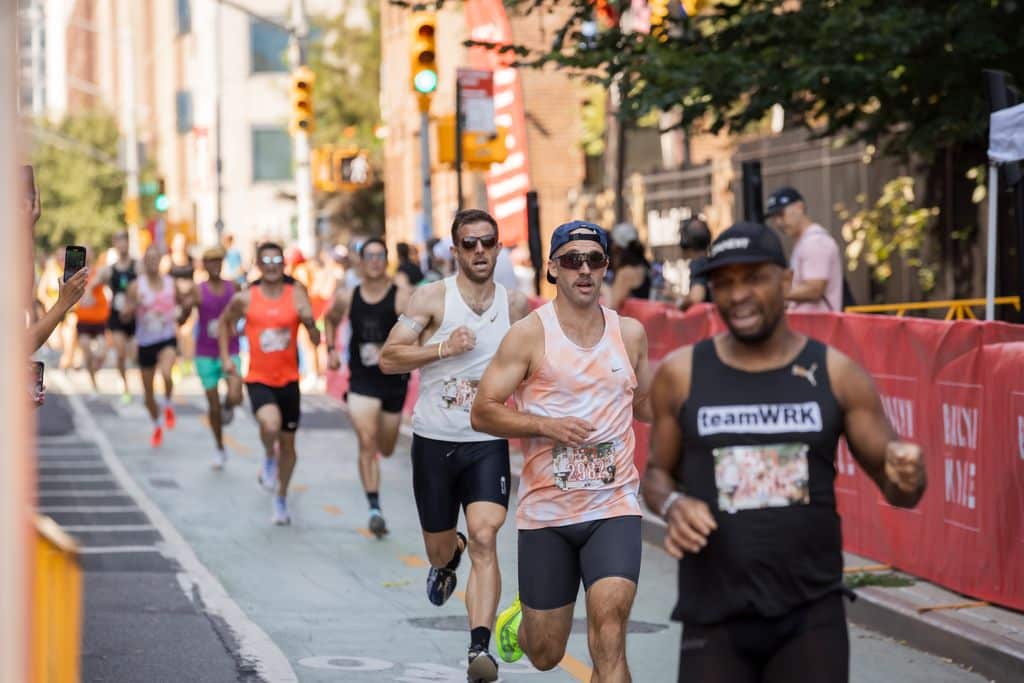
How Fast Can You Run a Mile? The Definitive Guide to Middle-Distance Success
Whether you are targeting a personal best or looking to conquer your local road mile, racing exactly 1,609 meters is a unique physiological test. It demands a blend of top-end aerobic power, raw speed, anaerobic capacity, and psychological grit.
To run your absolute fastest mile, you cannot rely on generic distance training. You need a scientifically validated approach. In this comprehensive guide, we break down the physiological keys to running your best mile based on the legendary principles of Dr. Jack Daniels’ Daniels’ Running Formula. We also provide target workouts to transform your fitness, and outline a race-pacing strategy that will prevent you from underachieving before the final 400m.
The Physiology of the Mile: What It Takes to Run Fast
Many runners mistake the mile for a prolonged sprint, while others treat it like a mini 5K. In reality, exercise science shows that the mile sits right on the edge of human energetics. A classic study by Spencer and Gastin (2001) confirms that an all-out effort lasting around 5 minutes relies on roughly 55–65% aerobic metabolism and 35–45% anaerobic metabolism.
To maximize your performance, your training must methodically address three critical physiological pillars outlined in Dr. Daniels’ VDOT methodology:
1. VO2max
Because the mile is predominantly aerobic, your body’s ability to transport and utilize oxygen is the foundation of your performance. In the VDOT system, this is targeted via Interval (I) Pace.
Building a massive aerobic engine does more than just power you through the middle laps of the race; it directly dictates how quickly your body clears metabolic byproducts and restores muscular equilibrium during hard training. A high VO2max allows you to recover rapidly between high-intensity intervals, meaning you can stack higher-quality repetitions within a single training session.
2. Running Economy and Speed
Running economy refers to the volume of oxygen you consume at a given submaximal speed. If you can move efficiently, you use less energy, leaving more fuel in the tank for a ferocious kick. In Daniels’ Running Formula, running economy, mechanical efficiency, and neuromuscular power are developed through Repetition (R) Pace.
Dr. Daniels frequently emphasizes that R sessions should feel fast and crisp, but never so forced that your running mechanics break down. If you struggle or strain to hit unrealistic times, you defeat the exact purpose of the workout: cultivating relaxed, efficient power.
3. Anaerobic Capacity and Lactate Buffering
During the latter half of a mile, your aerobic system can no longer keep pace with energy demands. Your anaerobic system steps in to fill the deficit, which leads to a rapid accumulation of hydrogen ions and metabolic subproducts in the skeletal muscles. To maintain velocity when your legs are “burning,” your body requires strong anaerobic capacity and an exceptional buffering system, both of which are sharpened by specific middle-distance training.
The Workouts: Building Your Middle-Distance Engine
To improve these systems, incorporate structured VDOT sessions into your training cycle.
Note: To ensure maximum safety and physiological efficacy, ensure you calculate your exact, current Interval and Repetition paces using the online VDOT Calculator or the V.O2 app. Never guess your training paces.
Legend:
E = Easy Pace | I = Interval Pace | R = Repetition Pace | min = Minutes | rec = Recovery
Workout 1: The Aerobic Engine & Recovery Builder (I-Pace)
Targeting: VO2max, stroke volume, and cellular recovery efficiency.
- Warm-up: 15–20 min E running, followed by 6x100m strides (at least 1 min rest between each)
- Main Set: 5 x 3-min at I Pace, with a 2-minute jogging recovery between each work bout.
- Cool-down: 10–15 min E running.
- Coach’s Tip: The recovery should be active but easy. Don’t rush into the next Interval until the full 2 minutes have elapsed; the goal is to keep the quality of the hard reps high.
Workout 2: The Neuromuscular Efficiency Session (R-Pace)
Targeting: Running economy, fast-twitch motor unit recruitment, and speed mechanics.
- Warm-up: 20 min E running, followed by dynamic mobility drills.
- Main Set: 3 sets of [2 x 200m at R Pace (with 200m jog between) + 1 x 400m at R Pace (with 400m jog rest].
- Cool-down: 10 min E running.
- Coach’s Tip: Focus heavily on staying completely relaxed. Keep your shoulders loose, your jaw unclenched, and your stride fluid. If your form gets sloppy, slow down slightly and/or go slower on the recovery jog.
Workout 3: The Mile-Specific Simulator (Mixed Tier)
Targeting: Mental toughness, specific pacing control, and the transition from aerobic to anaerobic energy production.
- Warm-up: 15 min E running, followed by 3x200m progressive strides.
- Main Set:
- 1 x 4mins at I Pace (3 min walk/jog recovery)
- 2 x 400m at R Pace (400m jog recovery)
- 4 x 200m at R Pace or slightly faster (200m jog recovery)
- Cool-down: 15 min E running.
Tactical Mastery: How to Pace Your Best Mile
You can have the fitness of an Olympian, but if you execute a poor tactical strategy on race day, you will fail to hit your true potential.
Most runners go out way too fast over the first 400 meters. This error puts you into oxygen debt and forces a deceleration during the critical middle sections of the race. Typically, runners will then “settle” on the second 400m and the third 400m tends to mimic the second 400m. Because you are super fatigued on the third 400m the same pace will feel much harder and may make you think like you’re actually picking it up.
Instead of an aggressive and adrenaline induced surge at the line, follow this formula to structure a four-lap track mile or a perfectly executed road mile:
1. Controlled: 0 – 400 Meters.
Resist the initial adrenaline rush. Run the first quarter-mile at a pace that is actually one to two seconds slower than your realistic, target goal mile pace. This preserves your anaerobic fuel tank and prevents early systemic shock.
2. The Concerted Surge: 400 – 800 Meters.
Make a deliberate, conscious effort to shift gears. Your goal here is to make this second quarter-mile two to three seconds faster than your first lap. This brings you perfectly back on your target average pace without overtaxing your heart and lungs.
3. Maintaining Momentum: 800 – 1200 Meters.
This is historically the hardest part of the race. Physiologically, your body will want to slow down. However, because you ran a smart, conservative first lap, your body has the capacity to maintain velocity. Concentrate on duplicating the effort of your second lap. By going out a tad conservative and anchoring your focus on matching Lap 2, you bypass the typical third-lap slowdown.
4. Empty the Tank: 1200 – 1609 Meters.
With only one quarter-mile remaining, you are now in a better position physiologically and psychologically to kick home faster than you thought. Leave everything out there and finish strong focusing on quick turnover.
Put Your Fitness to the Test: The BKLYN Mile
The ultimate arena to test your new training and execution strategy is the upcoming BKLYN Mile. Running straight through the vibrant heart of Brooklyn, this premier road race is fast, electric, and the perfect place to drop a massive PR.
As a proud official sponsor of the event, V.O2 wants to make sure you step up to the starting line fully prepared.
We are thrilled to offer all registered BKLYN Mile participants a complimentary 6-week custom training plan powered by our state-of-the-art VDOT Adaptive Trainer.
This digital training platform applies Dr. Jack Daniels’ scientific formulas directly to your personal metrics. It analyzes your current fitness level, calculates your exact training paces, and automatically adjusts your workouts dynamically as your fitness improves over the six-week block. No guesswork, no generic schedules—just highly optimized, scientific programming delivered straight to your device.
Don’t leave your performance to chance. Secure your spot at the starting line, claim your personalized training block, and discover exactly how fast your one-mile potential truly is.
Want to claim your complimentary 6-week BKLYN Mile training plan? Accept our free coaching invite.




Leave A Comment